SE Colorado Birding

Birding and discussion: A conservation-oriented birding blog that emphasizes low-impact birding and sustainable birding practices together with the enjoyment of birds. Southeast Colorado offers a diversity of habitats which provide premiere birding opportunities. Save Sabal Palm

Tuesday, June 26, 2007

Northern Mockingbird a'singin


Just a few miles south of Canon City, in the Breeding Bird Atlas that I am surveying, I found this singing Northern Mockingbird. I had heard several mockingbirds singing in this block but didn't see one until today.

Though both males and females sing, the Birds of North America online states that females rarely sing in the summer so this is most likely a male. And sing this one does, as shown the bottom pic.
SeEtta

Labels:

|

Sunday, February 04, 2007

More Northern Mockingbird


Here is the photo that I cropped closer to enlarge. Just an interesting note is that this bird has light arcs above and below it's eye. I have not seen anything about this type of pattern in the field guides or other sources. Interestingly I see this characteristic, or sometimes a ring around the eyes, in photos of other Northern Mockingbirds in field guides and on the internet. Not sure what this means, maybe there are so many other distinctive field markings that it was considered unnecessary to list this?

Since lighting and angle (as well as the color accuracy of computer monitors) can influence the perception of color, I have looked at a number of photos I took of this bird and have posted 3 (2 yesterday) to this blog for others to check out. Also, it is standard to consider more than one field mark when making identifications due to individual variation and other sources of error. Unfortunately I was unable to find other field marks to differentiate an immature from an adult. I thought that the tail feathers (rectrices) might help but according to Birds of North America (BNA)online, "Differences in rectrices are of limited use in aging or sexing birds due to extensive variation among individuals."

Why is this bird not a juvenile? Birds of North America online states that this species undergoes it's first molt from juvenal to "pre-basic" (immature/1st winter) plumage in late summer. Northern Mockingbirds in juvenal plumage have breasts spotted with brownish to blackish spots and streaks. This bird has some brown streaking on its neck and flank. Adult birds have a buffy wash on the their flanks. I don't know about the brownish streak on its neck, it could some leftover juvenal feathers or it could be nothing more than individual variation.

Learn more about this species. And check out a close-up of the upper tail feathers and upper tail coverts (on top of the tail upper tailfeathers at the base) by double-clicking the bottom pic. Another interesting thing about this bird is that it appears in this, and a number of other pics I took, to not have the usual white outer tail feathers (rectrices)that is mentioned as a field mark for this species.
SeEtta
Labels: ,

|

N. Mockingbird eyes (and tongue)


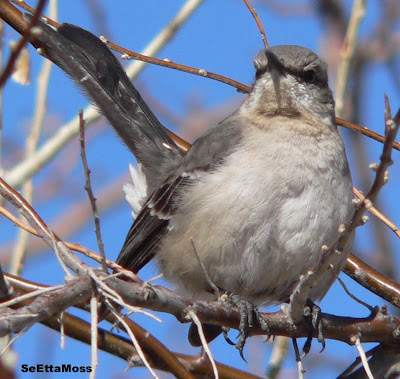
I have cropped this pic to zoom in on the head and body (less the long tail)of the Northern Mockingbird I photographed yesterday at the Pueblo Reservoir. Besides providing some great eye and feather detail for my rather esoteric exercise about deciding the age of this bird, I think it provides those not concerned with such exercises with the opportunity to see a Northern Mockingbird "upclose". This includes the opportunity to see the bird's tongue (and toenails) which is something most of us don't often see on smaller birds unless someone has the bird "in-hand" at a banding station. As I have noted before, detail is best seen by double-clicking on the photo to enlarge it.

But the main point for age identification is the eye which appears to me to be gray-green. The iris of adult birds per Birds of North America online is ". . .light green-yellow to dark yellow or occasionally orange . . ." Field guides either say the eye is yellowish/orangish or show illustrations with a yellow eye for adults and grayish eyes for juveniles.

For comparison, see photos of adult Northern Mockingbirds at Cornell Lab of Ornithology (have to click again on the photo to enlarge it) or at Patuxent Wildlife Research Center (again double-click on all 3 photos to see eye color). Both of these are highly respected ornithology resources.

I will try to crop this photo for my next post just to the head to see if the eye will enlarge further.


SeEtta

Labels: ,

|

Saturday, February 03, 2007

Pueblo Reservoir Northern Mockingbird


In a December, 2006 I posted about a Northern Mockingbird I found at the Pueblo Reservoir. I added a not-so-hot photo of the bird which was rather camera shy. Today I saw a Northern Mockingbird in the same location where I found the December bird (so likely the same one as this species). However, today the mockingbird was a great photo subject as can be seen by these two pics (remember that I am using a 12X digital zoom). I stayed in my car so as not to disturb the bird (it makes more sense to not disturb birds as these photos demonstrate).

Though not real rare, this species is found very infrequently in winter here in Colorado. I believe that this is one of two Northern Mockingbirds reported at the Pueblo Reservoir this winter. Sometimes we have one winter in Canon City but I don't know of any this year here or that have been reported recently in other areas of Colorado. Birds of North America online notes that this species tends to stay year-round except at northern edges of its range. They further note that they believe these birds in winter do migrate out of the state but note that "some remain in urban areas." It further states, "Perceptions of status could be affected by reduced visibility of mockingbirds during winter." So I guess there may be more Northern Mockingbirds in Colorado than are seen and reported.

I recommend double-clicking on the photos to enlarge them so their feather to toenail detail can be seen. By doing so it is possible to see plumage and eye characteristics that indicate this is an immature bird (more on that tomorrow, it's getting late)

SeEtta

Labels: , ,

|
Save trees in the Boreal forest for birds, not for paper--Opt out of catalogues

Weblog Commenting and Trackback by HaloScan.com

  • Blogarama - The Blog Directory